This is a blog created for Basic Composition's Class dictated at USFQ.

domingo, 12 de diciembre de 2010

Amazonian Turtles.

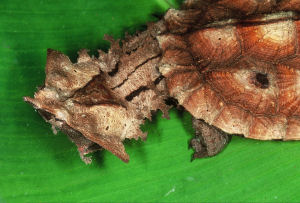
Turtles are old creatures in the evolutionary sense. The turtles seen today in Amazonian waters belong to a relatively ancient group called side-necked turtles (Pelomedusidae), which date back to the Cretaceous era. Side-necks do not pull their heads directly back under their shell, but rather tuck them sideways. The matamata (Chelus fimbriatus)  looks prehistoric, an imposing turtle that somewhat resembles snapping turtles.


Riverbanks, ought to be lined with basking giant arran turtles (Podocnemis expansa), which can weigh in excess of 45kg. Unfortunately, arran turtles have been so seriously reduced by hunting pressure, for both their meat and their eggs, that the species is now considered endangered, and they can be seen only in a few protected reserves. The turtle meat is quite edible, and it has been argued that the yield from turtles would be 400 times that of cattle if rainforest were converted to equivalent to pasture. But there is a problem, turtles don’t appear to bred well in captivity, so thus far arran turtles have yet to become “hamburgers on the halfshell”. And the species remain endangered. 

An astonishing serpent.

The largest of all the New World snakes is without doubts, the greatest golden brown anaconda (Eunectes murinus), his distribution ranges is throughout all the Amazonian Basin.


 Anacondas can reach nearly 10mts (30 ft aprox). Anacondas are wider in body than pythons and are considered to be the bulkiest of the world’s snakes. Anacondas feed on agoutis, capybaras, peccaries, tapirs, large birds, and even crocodiles and caiman. Anacondas will avoid humans by taking shelter under water. Nonetheless, it´s not a good idea to disturb a long anaconda (6,1 mts in average). 


viernes, 10 de diciembre de 2010

Yasuní

Over the past decade, biologists who work in Yasuní National Park, have documented Yasuni's remarcable biodiversity, they prove that Yasuní forest has the highest number of species of the planet, including an unprecedented core where there are overlapping world richness records for amphibians, reptiles, bats, and trees.


A group called Scientists Concerned for Yasuní (SCY),  these researchers have waged an international campaign to protect the location, which happens to sit atop Ecuador's second largest reserve of crude oil. This unabashed science-based advocacy has had an impact. In 2007  Ecuador President Rafael Correa offered a proposal in which his country would  in exchange for several billion dollars keep the oil permanently under ground. 


The innovative initiative took a significant step toward reality this summer when the United Nations agreed to oversee a trust fund paid to Ecuador for the project. If all goes according to plan, the initiative may serve as a model for preserving intact biodiversity in other oil-rich portions of the western Amazon. But that's a big "if": President Correa has vowed to allow drilling if the international community fails to compensate Ecuador sufficiently.


lunes, 6 de diciembre de 2010

Dolphins and manatees.

Dolphins and manatee are aquatic mammals; there are two species of freshwater dolphins and one manatee species in the Amazon and Orinoco rivers. The largest and most widespread of the two dolphin species is the pink river dolphin (Inia geoffrensis). Depending of the region, the animal is known by several common names. In Spanish-speaking areas is usually called bufeo o tonina, while in Portuguese Brazil it is known as boto. 

All dolphins, along with the whales, are mammals in the order Cetacea. Dolphins belong to the Odontoceti, the toothed whales. Pink river dolphins hunt for fish and other aquatic animals (turtles, crabs) in muddy waters of the Amazon and Orinoco basins, and they readily forage among the trees of flooded forest. Unlike the majority of dolphins, pink dolphins, have a flexible neck, they are nearly blind but have an effective sonar, permitting them to navigate among the dense trunks of the forest. There is a legend with the pink dolphin, for example, if a young woman is pregnant and the father is unknown, the baby is attributed to the dolphin.


The second species is Sotalia fluviatilis, the Tucuxi or gray dolphin; Tucuxis are smaller than pink dolphins and have a shorter snout, a much less bulbous head, and a more distinctive triangular dorsal fin. They tend to show much more of the head when they surface than pink dolphin. In general, Tucuxis are easier to see well as they often leap from the water and tend to be found in larger groups than pink dolphins.


The Amazonian manatee; (Trichechus inunguis). Manatees are mammalian order Sirenia and there only four species on the Earth. The Amazonian manatee can weigh up to 500 kg. It’s is hard to confuse the manatee with another animal. They have smallish, puffy-looking heads adorned with a wide, blunt snout and short whiskers. Their eyes are small but they will have a look around when they surface to breed. Manatees are vegetarians feeding in quiet waters that host an abundance or water lettuce or water hyacinth. 


sábado, 13 de noviembre de 2010

Artificial leaves can produce electricity.

Artificial leaves, which are water-gel based solar devices, can act like a solar cells in order to produce electricity,  a result shown by a study led by North Carolina State Researcher, co-autored by Researchers from the AFR laboratory and Chung-Ang University in Korea. They prove a concept for making solar cells by resembling the nature. This new technology can be less expensive and much more enviromental friendly compared with the silicon based solar cells.


Researchers used the plant chlorophyll coupled with carbon coated electrodes materials like carbon nanotubes or graphite in one of their experiments. This light sensitive molecules get exited by the sun rays and produce electricity just like plant molecules get excited to synthesize sugars in order to grow.


Now the research team, are working to mimic the self-regenerating mechanisms found in plants. Although this new technology looks promising, there is a long way to go before this can become a practical technology. Dr Orlin Velev (lead author of the paper) says "However, we believe that the concept of biologically inspired soft devices for generating electricity may in the future provide an alternative for the present day solid-state technologies"

miércoles, 3 de noviembre de 2010

Physics behind geckos.


Geckos are reptiles from Gekkonidae Family, generally they are small animals. From all the lizards (Squamata) Gekkos are the most specialized taxa. There are some studies argue that geckos are even more diverse and successful than true Lizards.

Geckos has been developed one of the most effectives and versatile form of adherence to the surface of all the animal kingdom, their feet contains millions of tiny, tiny microfibrils kwon as a setae.
This setae are only  a tenth of a millimeter long. (Half the size of a typical paramecium). each one of this branches into thousands of different endings called spatulae, this spatulae are so small that they can't be seen with visible light, the unique way to see it is under UV light. The average length of this spatulae is 0,2 um.


So, in average,  each of one of a gecko's four feet has almost four billions of. When all of this spatulae are in contact with any surface, they create millions of weak molecular attractions called Van der Walls forces, 
The way these work is pretty simple, and it works similarly to how you can rub an inflated balloon on your cotton shirt, stick it to the wall (or your hair), and have it stay, held up by static electricity. 


The edges of the spatulae get a random charge, either + or - on the tip. When they come near a surface, it causes a charge separation on the surface, and this makes a small, close-range, temporary attraction, like so:
When you get many of these together, they can form a lattice, and result in an extremely large force. The charges will change over time, but as long as they all change together, the attractive force will remain strong, and thus the gecko will remain stuck to the wall.


This amazing capacity of geckos has been studied and reproduced by scientists and biomechanists.  they build artificially setae in order to create new adhesives, (without toxic materials) and even robots that can climb in a lot of surfaces. 


martes, 2 de noviembre de 2010

Pitvipers.

Pitvipers are all venomous, There are many species found throughout America. The “pits” referred to in the name are sensory depressions located between the nostrils and eyes. They sense heat and aid the snake in locating warm-blooded prey. Pitvipers have long hypodermic fangs in which a poison duct from modified salivary glands can deliver a lethal dose of biochemically complex toxin that attacks blood cells and vessels, surrounding tissue, and sometimes nerve tissue. Pitvipers tend to rest in a coiled position, which they also assume when danger threatens. Any pitviper may be aggressive in display, raising its head high and vibrating its tail. Rattlesnakes normally have large, triangular-shaped heads and slitted, catlike eyes.


The most famous (or infamous) Neotropic pitviper is the fer-de-lance or echis snake (Bothrops asper). This snake has brown dark diamond patterning along its sides. His average length is 1,2-1,8mts but some individuals reach 2,5 mts. Regardless of size, a fer-de-lance is a potentially lethal snake: even the juveniles are highly venomous. The genus Bothrops are responsible for more human morbidity in the Neotropics than any other group of venomous snakes. Venom is fast acting and painful. It rapidly destroys blood cells and vessels and produces extensive necrosis (descomposition) of tissue around the bite site. Infection can follow and can be massive. Mortality without treatment is about 7% but is reduced between 0,5%-3% if properly treated. 


martes, 12 de octubre de 2010

Tapirs.

Tapirs (genus Tapirus) are Perissondactyls, or odd-toed ungulates. evolutionary relatives of rhinoceroses and horses. Only four species of tapir occur in the world, and three of them are in the American tropics. Tapirs are stocky, almost hairless animals, brownish to black depending upon species, with a short elephantine proboscis and a dense but short mane of stiff hair in the upper neck. The name probably aids the animal making its way through dense undergrowth. Tapirs have and acute sense of smell and select food plants at least in part on the basis of odor. They eat only vegetable matter, including leaves and fruits of various species.


The three Neotropical tapir species are separated by range and habitat. The most widespread is the Brazilian tapir (Tapirus terrestris) which can be found east of Andes from northern South America throughout Amazonia as far south as Paraguay. The Baird’s tapir (Tapirus bairdii) ranges throughout Central America and northern South America west of the Andes. The mountain tapir, (Tapirus pinchaque) has the most restricted range and is, as the name implies, confined to higher elevations. It inhabits the paramos of the central and eastern cordilleras of the Andes, from Colombia to Ecuador. 


domingo, 12 de septiembre de 2010

Birding in Quito.

Quito is a place where almost anyone can do birdwatching, here you will find different species, from ducks to falcons, pigeons to hummingbirds, here I will give you some advices for birding, both how to identificate different species and where to find them . 


Quito parks are the best place to start your bird-journey, Guanguiltagua metropolitan park  has the most diversity of birds in the city, followed by the "reservorio" located in Cumbayá valley. In order to facilitate the use of this little guide, I will divide the city in four regions, south, center, north, and valleys. 

South: 

In this part of the city you can find a lot of small parks, and three medium parks. Here you will find the tipically bird species of urban Quito, among which are: 

Common birds. 

Eared Dove- Zenaida auriculata
Rufous-collared Sparrow-Zonotrichia capensis
Great Trush-Turdus fuscater
Sparkling Violet-ear-Colibrí coruscans
Common dove-Columba livia

Fairly common birds. 

Black-tailed Trainbearer-Lesbia victoriae
Vermilion Flycatcher-Pyrocephalus rubinus
Brown-bellied Swallow-Notiochelidon murina. 
Blue-and-white Swallow-Pygochelidon cyanoleuca
Black Flowerpiercer-Dyglossa humeralis
Blue-and-yellow Tanager-Traupis bonariensis
Yellow-breasted Brush-finch-Atlapetes latinuchus. 

Non common birds. 

American Kestrel-Falco sparverius. 

Center:

In the center of Quito, the principal place to birdwatch is Itchimbia park, here you will easily find a lot of types of birds. 

Itchimbia park:


Black Vulture - Coragyps atratus  
American Kestrel -   Falco sparverius 
Band-tailed Pigeon - Patagioenas fasciata 
Eared Dove  - Zenaida auriculata 
Sparkling Violet-ear -    Colibri coruscans 
Black-tailed Trainbearer -   Lesbia victoriae 
White-crested Elaenia  - Elaenia albiceps 
Azara's Spinetail  - Synallaxis azarae 
Brown-bellied Swallow  - Notiochelidon murina 
Great Thrush  - Turdus fuscater 
Rufous-collared Sparrow - Zonotrichia capensis 
Grassland Yellow-finch  - Sicalis luteola 
Black-and-white Seedeater  - Sporophila luctuosa 
Band-tailed Seedeater  - Catamenia analis 
White-winged Brush-finch - Atlapetes leucopterus 
Blue-and-yellow Tanager  - Thraupis bonariensis 
Cinereous Conebill  - Conirostrum cinereum 
Black Flowerpiercer  - Diglossa humeralis 
Golden-bellied Grosbeak  - Pheucticus chrysogaster 
Crimson-mantled Woodpecker  - Colaptes rivolii 
Tufted Tit-tyrant  - Anairetes parulus 
Vermilion Flycatcher -    Pyrocephalus rubinus 
Tropical Kingbird  - Tyrannus melancholicus 
Eastern Kingbird  - Tyrannus tyrannus

North: 


In the north of Quito, there are two big parks where to find birds, in one of them, Carolina Park, there is a Botanical Garden, inside of it you can find migratory species, some colorful tanagers, egrets, herons, finches, and more.

Not far away from the botanical garden, about 10 minutes west, there is the Metropolitan Park of Guanguiltagua, there you can find hummingbirds, actually there is a road called "Sendero de los Colibries". Metropolitan Park is an intermedial stage between Quito and the valleys of Cumbaya and Nayón. There you going to find three viewpoints, each one has a different view of the slopes, In this slopes you can observe communities of birds.


domingo, 5 de septiembre de 2010

Parental Care in Glass Frogs

The glass frogs, are Anuran amphibious of the family Centrolenidae, this tiny animals present in the majority of his species a light green dorsal coloration, and his ventral part is almost always transparent, because of this special feature, easily you can see his intern organs such as his stomach, the liver, his bowels, and also you can see the beat of his heart. The majority of the centrolenid species has parental care, which means that father, mother, or inclusive both parents stay with their eggs and take care of them until the juvenile frogs emerge.


This special behavior, has to do whit terrestrial reproduction, unlike the majority of the amphibias, the glass frogs put his eggs under the leaves. Generally the males stays whit them day and night protecting it of potential predators such as wasps, insects, or other amphibians, also the males prevents the desecation of his eggs producing continiously a gelatinous liquid whit special glands that are located in the back of the animal, also this liquid prevents possible fungi and bacterial infections. 

They reproduction behavior is well documented, the male stays exposed over a leaf or a stone, and he begins to call, this call is named a reproductive song, the male who song more louder and faster will atract more females, then the male do a reproductive "hug" called amplexus to the female, once her is fertilized, she puts a bag of eggs over or under the leaf where the male was. 

After copulation, he stays close to the eggs whitout touching them, or over the eggs, it depends of the specie, generally male protects the eggs at night, and watch them from a near place, but has been cases that he stay whit the eggs day and night. The male is in  alertness but he does not move, his metabolic rate descends according to face all the dangers that he could be exposed (solar radiation, lack of food, dehydration, etc.).

Once the eggs emerge (14 days on average) and the male conduce them to the water and there he finished their work only for sing another reproductive song...