This is a blog created for Basic Composition's Class dictated at USFQ.

domingo, 12 de diciembre de 2010

Amazonian Turtles.

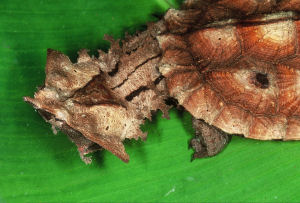
Turtles are old creatures in the evolutionary sense. The turtles seen today in Amazonian waters belong to a relatively ancient group called side-necked turtles (Pelomedusidae), which date back to the Cretaceous era. Side-necks do not pull their heads directly back under their shell, but rather tuck them sideways. The matamata (Chelus fimbriatus)  looks prehistoric, an imposing turtle that somewhat resembles snapping turtles.


Riverbanks, ought to be lined with basking giant arran turtles (Podocnemis expansa), which can weigh in excess of 45kg. Unfortunately, arran turtles have been so seriously reduced by hunting pressure, for both their meat and their eggs, that the species is now considered endangered, and they can be seen only in a few protected reserves. The turtle meat is quite edible, and it has been argued that the yield from turtles would be 400 times that of cattle if rainforest were converted to equivalent to pasture. But there is a problem, turtles don’t appear to bred well in captivity, so thus far arran turtles have yet to become “hamburgers on the halfshell”. And the species remain endangered. 

An astonishing serpent.

The largest of all the New World snakes is without doubts, the greatest golden brown anaconda (Eunectes murinus), his distribution ranges is throughout all the Amazonian Basin.


 Anacondas can reach nearly 10mts (30 ft aprox). Anacondas are wider in body than pythons and are considered to be the bulkiest of the world’s snakes. Anacondas feed on agoutis, capybaras, peccaries, tapirs, large birds, and even crocodiles and caiman. Anacondas will avoid humans by taking shelter under water. Nonetheless, it´s not a good idea to disturb a long anaconda (6,1 mts in average). 


viernes, 10 de diciembre de 2010

Yasuní

Over the past decade, biologists who work in Yasuní National Park, have documented Yasuni's remarcable biodiversity, they prove that Yasuní forest has the highest number of species of the planet, including an unprecedented core where there are overlapping world richness records for amphibians, reptiles, bats, and trees.


A group called Scientists Concerned for Yasuní (SCY),  these researchers have waged an international campaign to protect the location, which happens to sit atop Ecuador's second largest reserve of crude oil. This unabashed science-based advocacy has had an impact. In 2007  Ecuador President Rafael Correa offered a proposal in which his country would  in exchange for several billion dollars keep the oil permanently under ground. 


The innovative initiative took a significant step toward reality this summer when the United Nations agreed to oversee a trust fund paid to Ecuador for the project. If all goes according to plan, the initiative may serve as a model for preserving intact biodiversity in other oil-rich portions of the western Amazon. But that's a big "if": President Correa has vowed to allow drilling if the international community fails to compensate Ecuador sufficiently.


lunes, 6 de diciembre de 2010

Dolphins and manatees.

Dolphins and manatee are aquatic mammals; there are two species of freshwater dolphins and one manatee species in the Amazon and Orinoco rivers. The largest and most widespread of the two dolphin species is the pink river dolphin (Inia geoffrensis). Depending of the region, the animal is known by several common names. In Spanish-speaking areas is usually called bufeo o tonina, while in Portuguese Brazil it is known as boto. 

All dolphins, along with the whales, are mammals in the order Cetacea. Dolphins belong to the Odontoceti, the toothed whales. Pink river dolphins hunt for fish and other aquatic animals (turtles, crabs) in muddy waters of the Amazon and Orinoco basins, and they readily forage among the trees of flooded forest. Unlike the majority of dolphins, pink dolphins, have a flexible neck, they are nearly blind but have an effective sonar, permitting them to navigate among the dense trunks of the forest. There is a legend with the pink dolphin, for example, if a young woman is pregnant and the father is unknown, the baby is attributed to the dolphin.


The second species is Sotalia fluviatilis, the Tucuxi or gray dolphin; Tucuxis are smaller than pink dolphins and have a shorter snout, a much less bulbous head, and a more distinctive triangular dorsal fin. They tend to show much more of the head when they surface than pink dolphin. In general, Tucuxis are easier to see well as they often leap from the water and tend to be found in larger groups than pink dolphins.


The Amazonian manatee; (Trichechus inunguis). Manatees are mammalian order Sirenia and there only four species on the Earth. The Amazonian manatee can weigh up to 500 kg. It’s is hard to confuse the manatee with another animal. They have smallish, puffy-looking heads adorned with a wide, blunt snout and short whiskers. Their eyes are small but they will have a look around when they surface to breed. Manatees are vegetarians feeding in quiet waters that host an abundance or water lettuce or water hyacinth.